

Several days ago, my friend Bradley Schurman sent me a press release.
Bradley is a demographic strategist, author of The Super Age, and one of the creators of the new Geography of Prosperity Index.
He knows I live in The Villages, Florida.
So when the index rankings were ready to publicly share, he sent me the release with a note. It arrived late in the afternoon on a Sunday and when I read it, I couldn’t stop thinking about it.
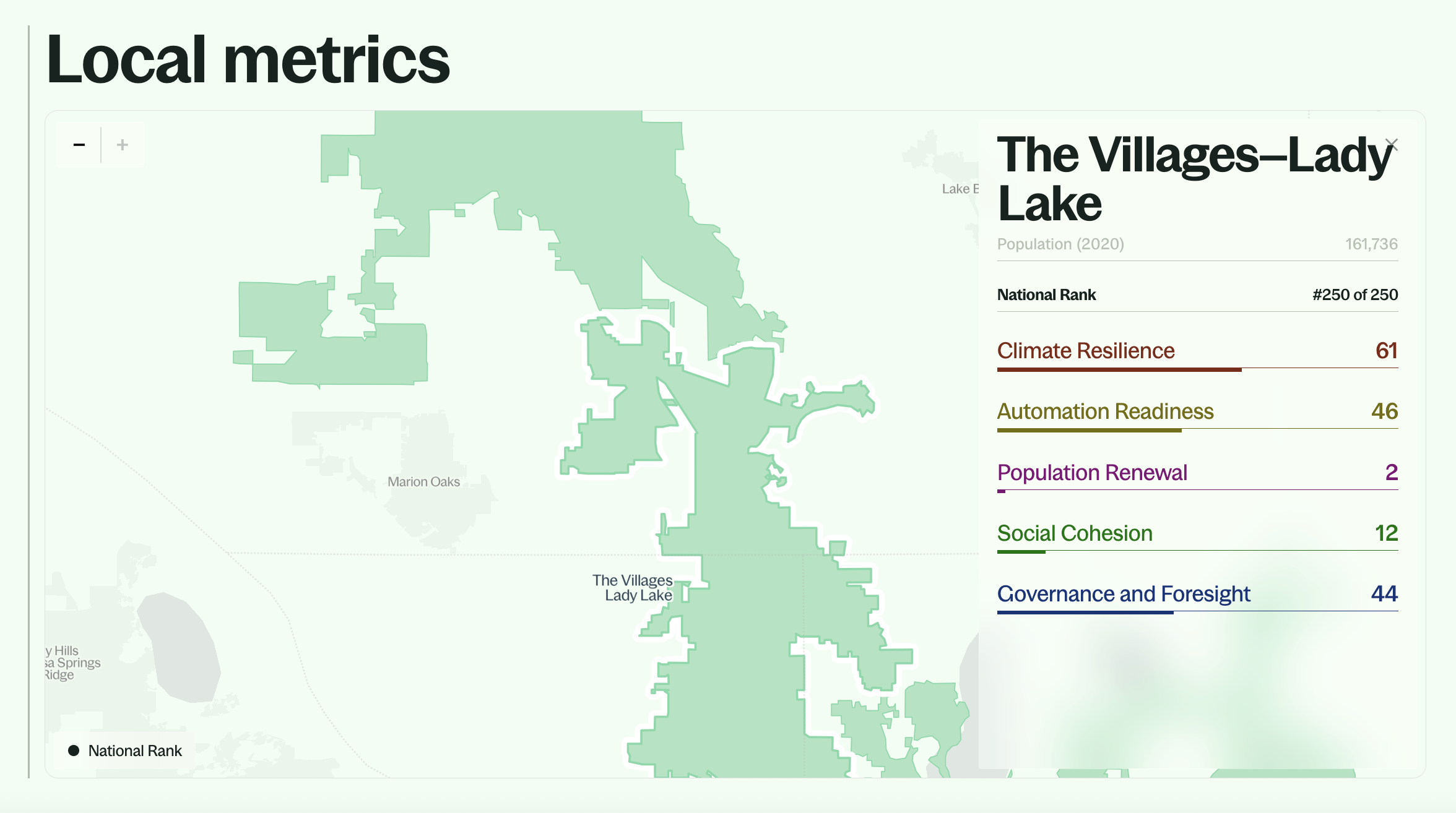
The headline was hard to miss:
The Villages—Lady Lake ranked last in America for long-term prosperity.
#250 out of 250 metro areas.
The index measures things like population renewal, automation readiness, climate resilience, governance, and social cohesion. According to the data, The Villages sits at the bottom. It has the lowest score in the country for both population renewal and social cohesion.
Bradley’s work is thoughtful and serious.
I admire it. And in many ways, the index is right.
A community built almost entirely around retirees looks, from a demographic standpoint, like a structural dead end.
Very few children. Very few young families.
An aging population with no way to renew itself.
On paper, the conclusion seems obvious. A place like this shouldn’t work.
And yet… I live here.
A Conversation That Stuck With Me
Not long ago I was talking with a neighbor, a married man in his early 60s who had recently moved to The Villages with his husband.
I asked him the obvious question.
“Why here?”
The Villages has a reputation, after all. Not exactly the first place people imagine when they think about reinvention.
His answer surprised me.
He told me they had looked at several places to live. Big cities. Beach towns. Smaller communities.
But something about The Villages felt different.
“Most places feel like people are winding down,” he said.
“Here it feels like people are starting things.”
That line has stuck with me.
Because it captures the paradox of this place better than any statistic could.
The Villages Is Optimized for a Phase of Life
To be fair to the index, the critique is valid. The Villages was not originally designed to be a multi-generational city. Instead, it has been designed around a very specific phase of life.
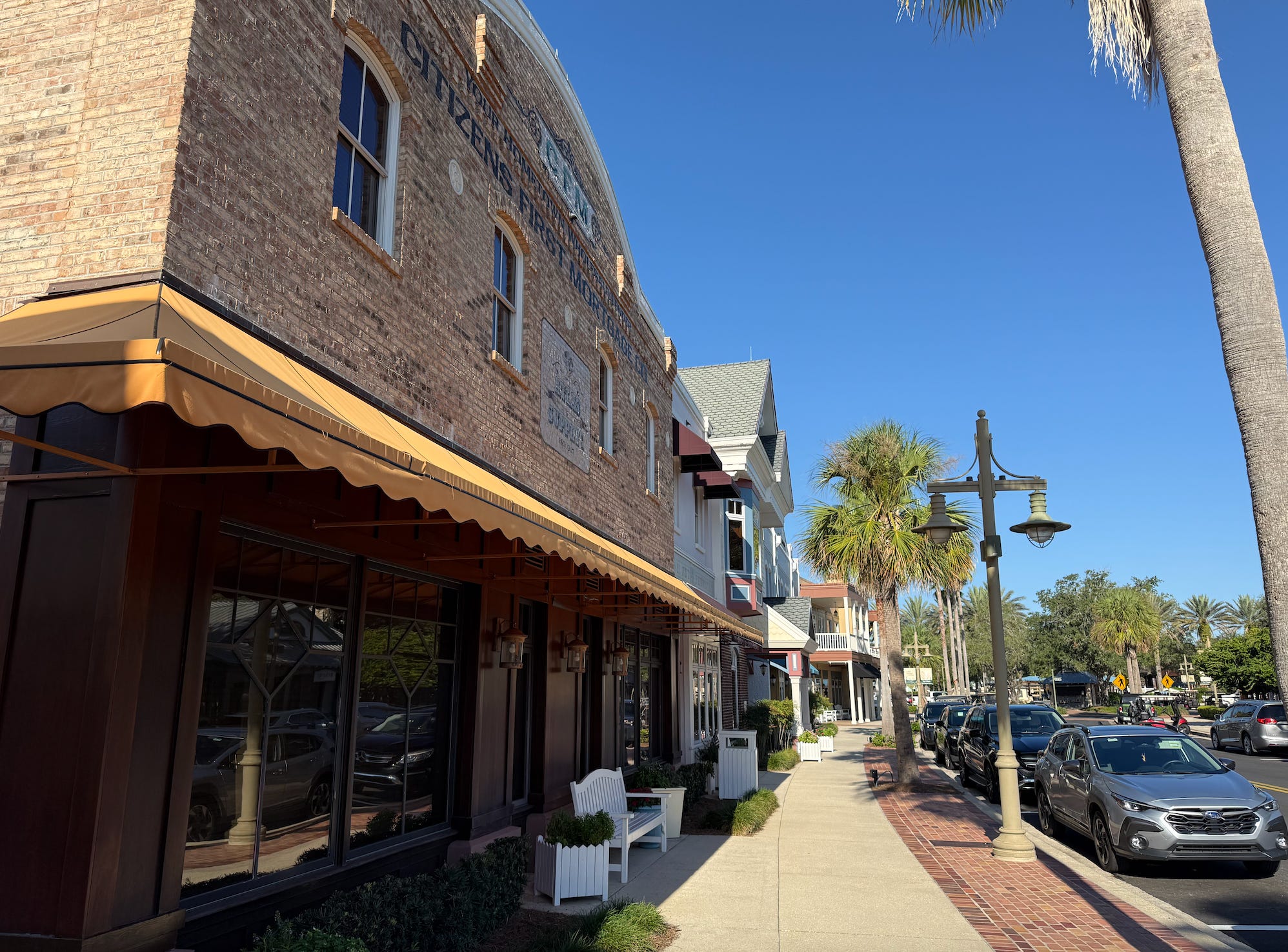
Everything about the place reflects that. The infrastructure, the housing, the town squares, the programming. It’s optimized for people asking a particular question:
What do I want the next chapter of my life to look like?
From an urban planning perspective, that kind of specialization comes with trade-offs. And the Prosperity Index is right to highlight them.
A community without population renewal eventually faces structural challenges: workforce shortages, service gaps, and long-term sustainability questions.
But living in The Villages reveals something the data doesn’t easily capture.
Social Connection Looks Different Here
One of the more surprising findings in the index is that The Villages ranks last in the country in social cohesion aka social connection.
That statistic depends heavily on how connection is measured.
Typical indicators include income diversity, generational mix, housing tenure patterns, and civic participation levels. Those are legitimate metrics.
But they miss something visible when you spend time in this community.
Shared life stage creates its own kind of social glue. People arrive having just stepped out of one identity like parenthood or a long-held professional role.
Suddenly they have space to experiment.
And because everyone else is doing the same thing, strangers talk to each other in ways that feel increasingly rare elsewhere.
Clubs form overnight. Neighbors invite each other to things. People try new identities out loud. In most cities or suburbs, social life often happens behind closed doors.
In The Villages, it spills out into public spaces.
Aging Becomes Visible Experimentation
There’s another design choice happening that often goes unnoticed. Most places treat aging as something that happens privately.
Inside homes, healthcare systems, and quiet routines.
The Villages does the opposite. It externalizes aging into public life. You see people learning instruments for the first time. They’re launching second careers, volunteering, studying languages, joining improv groups, and taking up photography.
None of this shows up in a demographic index.
But it’s everywhere.
What looks statistically like a retirement enclave often feels more like a laboratory for reinvention.
But the Data Is Still Warning Us About Something Real
None of this means the Prosperity Index is wrong. In fact, it’s pointing to a legitimate structural challenge. Communities need demographic renewal, younger workers, families, and they need a mix of life stages to remain resilient over time.
A purely age-segregated model can only go so far. Interestingly, the developers behind The Villages seem to becoming aware of this.
Over the past few years, they’ve been building something different alongside the traditional 55+ neighborhoods. It’s a multi-generational community called Middleton by The Villages.
And it’s where I chose to live — along with a wide range of residents who support, participate in, and contribute to this rapidly growing city of 160,000+ retirees.
Now, Middleton looks very different from the classic Villages model, yet it shares many similarities.
You’ll find families with kids, young professionals working remotely, midlife residents like me, employees of the developer working in downtown Middleton’s professional offices, and retirees who want a little more generational mix in their daily life.
The downtown area also brings together both Middleton residents and those living in the 55+ sections of The Villages on a daily basis.
Restaurants and shops fill up. Golf carts line the streets. Kids ride bikes past groups of retirees walking to dinner. Friday Night football games pack the state-of-the art charter high school’s 10,000 seat stadium.
It truly feels like a town designed for a longer lifespan. And whether intentional or not, it looks like an evolution of the experiment.
In fact, it might answer the very questions the Prosperity Index raises:
What happens when you begin layering generational diversity back into a community originally designed for retirement?
If The Villages represents one model of longevity living, Middleton may be pointing towards the next iteration.
We’ll see.
As the developer’s long-term plans continue to unfold over the next 20 years, The Villages experiment could become one of the most interesting demographic design stories in the country.
Living Inside the Paradox
Living as a 40-something makes this tension impossible to ignore. The Villages is both a demographic outlier and a cultural signal. From the perspective of traditional metrics, it looks fragile.
But from the inside, you also see something else.
A place where people are actively redesigning what later life can look like. Not perfectly and not without contradictions. But with experimentation that most communities never even attempt.
Which is why Bradley’s research matters.
The data reveals truths we shouldn’t ignore. And lived experience reveals something else. What looks fragile on paper can still point toward something new.
If The Villages, the world’s largest retirement community, is the first massive scale laboratory for designing communities built for longer lives, Middleton might suggest things aren’t exactly staying the same.
What Do You Think?
If you were designing communities for a 100-year life, what would a truly healthy version look like for you? Drop a comment. I read them all.
Until next time,
Rethink Aging With Us
This is for you:
If you’re in your 30s, 40s, 50s, or beyond and not ready to fade out.
If you’re a builder, strategist, or decision-maker trying to understand what aging really means for your product, team, city, or community.
If you’re tired of “decline narratives” about age and are ready for something more honest, more useful, and more human.
Join other curious and forward-thinking people who are reconsidering what older age can be — and how to live it with intention.
Share age/proof design
Enjoyed this issue? Please forward this to friends or share by clicking below:
Hey Bryan. Love your thought provoking articles. Thank you. I’m in Australia trying to get my head around what The Villages looks and feels like. We see the proliferation of ‘over 55’s’ living ‘resorts’ here but they are not integrated within the town. They are plonked there. Is The Villages more like the ancient Italian town design of the piazza as the central gathering place and retail surrounding it with residential around and on top? Our urban planning models are reliant on car transportation for most essentials. The polar opposite. They’re isolating. Can you help me understand? Thanks. Anita xx
I love that Middleton is being developed! This is what Asian countries are experimenting with success. We have so much to offer others of all generations; good for us and good for them. Putting us away, no matter how fun it might be for a while, is the opposite of what we and world truly need to understand and enjoy the value of older adults. Great article! Ardith