

The only weekly digest for forward-thinking people curious about the cultural and demographic shift reshaping the future of aging.
Written by a 40-something living inside the world’s largest retirement community. Here’s my roundup of actionable insights this week to help us rethink what older age can be.
This Week’s Pattern
A generation can be small without seeming scarce.
Its members still fill offices, schools, hospitals, city governments, and family group chats. They supervise teams, remember why old decisions were made, help children get started, and notice when a parent’s life begins slipping at the edges.
The imbalance appears slowly. One experienced person leaves. One sibling becomes the default caregiver. One institution keeps power in the same hands. One medical breakthrough proves harder to deliver than to discover.
This week’s stories point to the same pressure from four directions: more responsibility is gathering around a narrower group of people.
The Care Plan Nobody Made
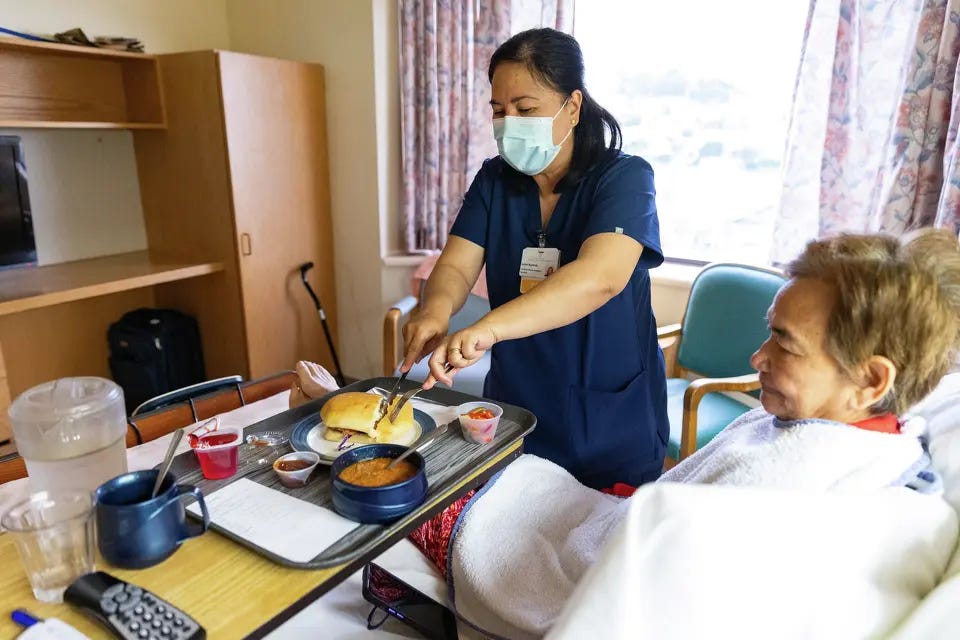
A parent may still live alone while small signs begin appearing: an unopened bill, a missed meal, a shower quietly avoided because getting in and out has become difficult. Families often enter caregiving before anyone uses the word.
Why it matters: Earlier limitations lengthen the period when help is needed. They also pull spouses and adult children into care while those family members are still working, raising children, and managing households of their own.
Real-world signal: Among Americans ages 65 to 74, unmet care needs rose from 11.1% in 2011 to 13.5% in 2022. Growth in that age group pushed the estimated number affected from 2.2 million to 4.2 million. Researcher Sarah Patterson described “younger older adults who are starting off older adulthood sicker and with more unmet care needs.”
Yes, but: The study does not establish why the increase occurred. The pattern also varied by age: unmet needs rose only slightly among adults 75 to 84 and declined among those 85 and older.
Hidden insight: Fewer middle-aged adults can mean fewer siblings, neighbors, and adult children available to divide the work. That turns a family responsibility into a concentration problem.
Takeaway: Make the care plan before one reliable person quietly becomes the entire plan.
Source: San Francisco Chronicle
Where Did Everyone in the Middle Go?
A veteran teacher retires. A longtime manager leaves. The neighbor who always ran the local fundraiser moves south. None of these departures makes national news, but a community can feel different after enough of them accumulate.
Why it matters: Adults between 45 and 64 often sit at the intersection of professional judgment, caregiving, income, and civic responsibility. Their numbers are falling while the country continues to rely on what they know.
Real-world signal: The U.S. population ages 45 to 64 declined by 2.68 million between 2020 and 2025, from 84 million to 81.3 million. During the same period, the population 65 and older grew 16.2%.
Yes, but: Part of the decline reflects generational timing. Younger boomers are leaving the age group faster than Gen X can replace them, and migration is shifting some of the loss from one region to another.
Hidden insight: Population growth can hide a loss of know-how. A place may add residents while losing the people who train colleagues, lead institutions, provide informal care, and remember how things get done.
Takeaway: Know which people your workplace or community cannot easily replace.
Source: Axios
What Happens When Power Won’t Move?
Longer lives allow people to remain active, influential, and productive for more years. They can also keep wealth, authority, and seniority in the same hands longer. That tension is easy to flatten into a fight between generations.
Why it matters: When leadership, housing wealth, and political influence accumulate by age, younger and middle-aged adults can spend more of adulthood waiting — for promotions, homes, inheritances, or policies that reflect their priorities.
Real-world signal: Yale professor Samuel Moyn argues that America has become a gerontocracy shaped by unusually wealthy older citizens. Visa estimates that boomers hold more than half of American wealth — about $93 trillion. Redfin found that Americans 70 and older now own 26% of the country’s real estate, more than adults ages 40 to 54. Moyn writes that “the rich today are old, to an astonishing extent.”
Yes, but: Age is a crude stand-in for power. Millions of older Americans have little wealth or influence, and many continue working because they cannot afford to stop. Moyn’s most provocative proposals also pull attention away from the evidence beneath them.
Hidden insight: A longer working life needs movement inside it. Institutions have to preserve experience while still allowing authority, ownership, and opportunity to pass between generations.
Takeaway: Ask whether experience is being shared or simply held.
Source: Fortune
The Breakthrough That Can’t Reach Everyone
Two cell therapies have cleared a regulatory threshold that no treatment of their kind had crossed before. Getting them approved was one problem. Producing them reliably for more than a limited number of patients is another. Regenerative medicine is entering the difficult stretch between scientific success and ordinary care.
Why it matters: Medical progress is usually described as a discovery problem. Living-cell treatments add another challenge: each therapy must be produced consistently despite biological differences among donors and patients.
Real-world signal: Japan granted conditional, time-limited approval to two therapies derived from induced pluripotent stem cells in March — one for severe heart failure and another for Parkinson’s disease. Separate research cited by the World Economic Forum found that cells from genetically diverse donors could be turned into high-quality neural tissue, with production conditions predicted from limited data.
Yes, but: Conditional approval is only an early step. The therapies still need confirmatory studies, and health systems must prove they can manufacture them consistently, affordably, and at a scale that reaches more than a small number of patients.
Hidden insight: A treatment becomes widely useful only after health systems can produce it consistently, pay for it, and deliver it beyond a small group of patients. Discovery may create the possibility. Infrastructure determines who benefits.
Takeaway: Judge a medical advance by the distance between approval and access.
Source: World Economic Forum
Until next time,
Rethink Aging With Us
This is for you and you’re in the right place:
If you’re in your 30s, 40s, 50s, or beyond and not ready to fade out.
If you’re a builder, strategist, or decision-maker trying to understand what aging really means for your product, team, city, or community.
If you’re tired of “decline narratives” about age and are ready for something more honest, more useful, and more human.
Join other curious and forward-thinking people who are reconsidering what older age can be — and how to live it with intention.
Share age/proof design
Enjoyed this issue? Please forward this to friends or share by clicking below: