

The only weekly digest for forward-thinking people curious about the cultural and demographic shift reshaping the future of aging.
Written by a 40-something living inside the world’s largest retirement community. Here’s my round up of actionable insights this week to help us rethink what older age can be.
Designing for Chance Encounters
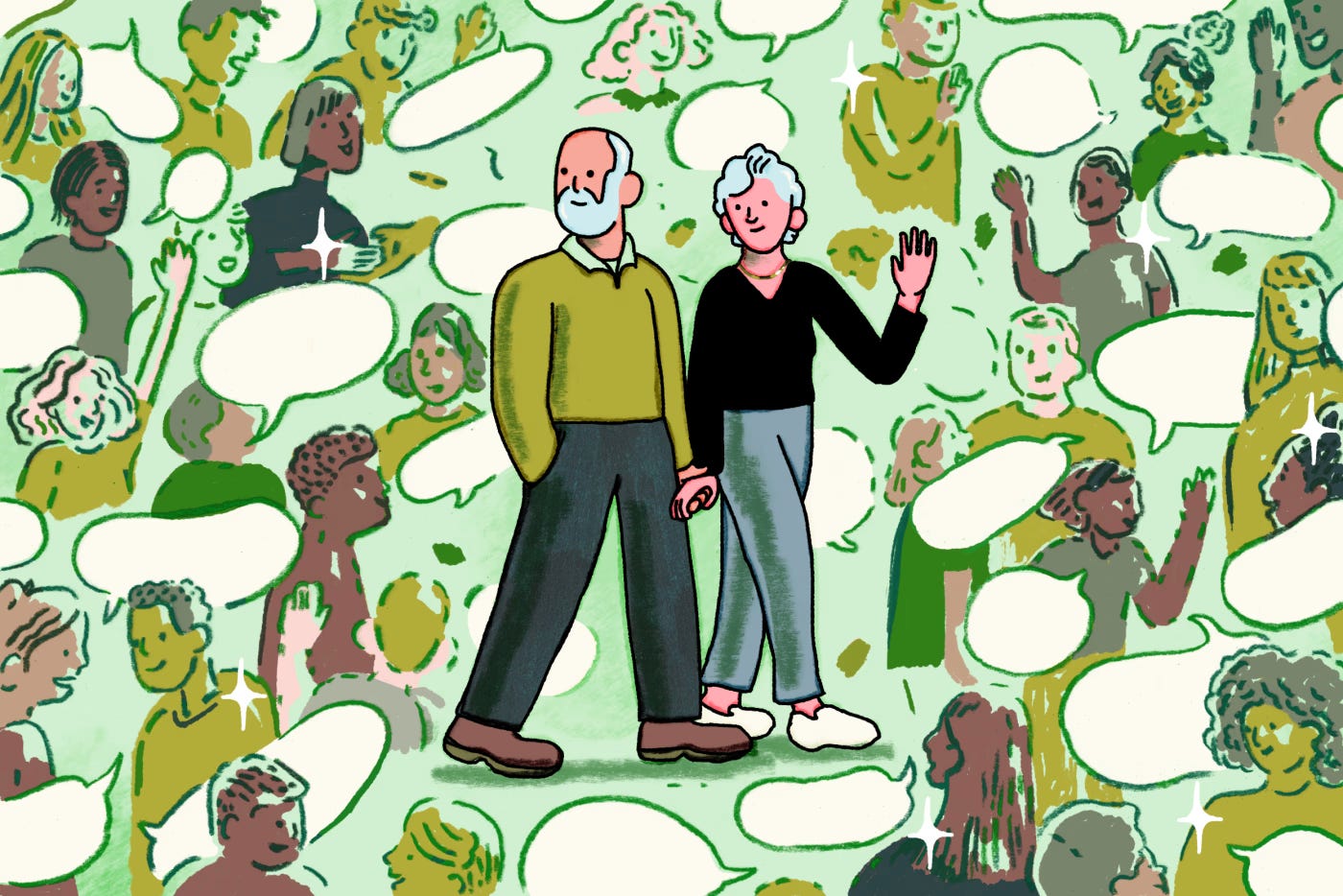
Research on long life continues to point to something simple but easy to overlook. We call it casual connection. These are the kind of day-to-day interactions that don’t require planning. Quick chats with neighbors, small talk at the cafe, impromptu hellos on a morning walk. All things associated with sharper thinking, better mood, and longer life. For many older adults, these low-pressure social moments keep the mind active and the body moving.
Why it matters: Health in older age isn’t just about medication, fitness, or even family. It’s also shaped by how often people see and speak to others, even briefly. That makes neighborhood design, public seating, sidewalks, and shared spaces part of the health equation. Planning for connection means building spaces where these interactions can happen naturally.
Real-world signal: The Wall Street Journal profiled adults in their 90s who credited long life not to specific regimens but to staying socially open and engaged. Conversations with acquaintances, neighbors, and shop clerks formed a daily rhythm.
Stanford psychology professor Laura Carstensen said, “Older people are more selective about who they spend time with, but those who are vital and active interact with a wide range of people.”
Yes, but: Access to this kind of social environment isn’t evenly distributed. People who live in car-dependent neighborhoods or lack public gathering spaces may find it harder to maintain these daily points of contact, especially if mobility becomes an issue.
Hidden insight: Social isolation doesn’t always mean loneliness. Sometimes, it just means there are fewer chances to be seen or heard. A long life needs places where those chances are built in.
Takeaway: Everyday contact isn’t just nice to have. It helps people stay alive and engaged.
Source: The Wall Street Journal
The New Middle Age Carries Three Generations
For many in their 40s and 50s, midlife includes more than career moves or personal reinvention. It often means supporting both aging parents and grown or semi-independent children. This “care squeeze” affects time, finances, and health. It’s also shifting how we think about middle age.
Why it matters: The caregiving structure most policies and workplaces still assume… they no longer hold. More people are navigating overlapping responsibilities. Women, in particular, are covering the most ground in this system, often at the cost of their own earnings or retirement plans.
Real-world signal: Reporting in The Times found that one in five middle-aged adults in the UK now supports both older and younger generations. The unpaid labor involved, largely carried by women, is valued in the trillions of dollars.
Heather McKay, an intergenerational researcher, noted, “The assumptions we built retirement around — like full-time grandparenting — don’t work anymore.”
Yes, but: Most financial and workplace systems still treat caregiving as a private issue. Few benefits or protections exist for those navigating the triple pull of kids, parents, and paid work.
Hidden insight: Middle age is no longer a holding pattern between independence and retirement. It’s a high-stakes, high-responsibility phase that demands new tools, protections, and recognition.
Takeaway: Products, workplaces, and policies that don’t account for care complexity are missing the reality of millions of people’s daily lives.
Source: The Times
Health Power Users
Women over 50 make most health-related decisions in the U.S., not just for themselves but for partners, parents, and children. They coordinate appointments, manage medications, and often carry the emotional weight of family health.
Why it matters: This group drives demand for care services, yet most digital health tools treat them as peripheral. Interfaces remain designed around younger users or individual patients rather than care networks. That’s a missed opportunity, especially as life expectancy rises and chronic conditions require longer-term coordination.
Real-world signal: eMarketer reports that women’s health decisions vary dramatically by life stage, but most platforms still take a one-size-fits-all approach. Women 50+ are heavy users, but not often consulted in product design.
As one strategist cited in the report put it, “They’re not just patients — they’re influencers.”
Yes, but: FemTech and digital health continue to focus on fertility and early motherhood. There’s limited investment in tools that support caregiving, menopause, or managing multiple chronic conditions — areas where midlife women have the most need and insight.
Hidden insight: Digital tools that ignore this demographic are missing both relevance and revenue. Designing with women 50+ at the center isn’t just inclusion — it’s market sense.
Takeaway: Health platforms built without midlife women in mind are unlikely to work for the people who use them most.
Source: eMarketer
Hiring Needs a Rewrite
Many older adults are staying in or returning to the workforce, bringing decades of experience and adaptability. Yet they often face screening systems and assumptions that keep them from getting a fair look.
Why it matters: With smaller incoming labor cohorts and longer lives, experienced workers are becoming more essential. But the hiring infrastructure still leans heavily toward younger candidates, with resume gaps, “culture fit” language, and skill test biases making it harder for older applicants to advance.
Real-world signal: A Wall Street Journal feature followed five older adults who re-entered the job market after layoffs or career breaks. Some took part-time roles while others pivoted industries or retrained.
Kerry Hannon, a workplace expert, said, “We have to stop treating experience as a liability.”
Yes, but: Reskilling alone doesn’t fix the problem. Many systems filter out older candidates before their applications are even seen, often because of outdated assumptions about tech ability or flexibility.
Hidden insight: The challenge isn’t older workers. It’s how hiring is structured. The systems weren’t built for long careers, and they’re not adapting fast enough.
Takeaway: If experience is still being screened out, the labor shortage will stay harder than it needs to be.
Source: The Wall Street Journal
Adaptation Is the New Retirement Strategy
A growing number of older adults are aging into longer lives without the retirement savings to match. Many are adjusting by working part-time, selling assets, or moving into shared housing. These are not fallback plans. They’re the new reality.
Why it matters: Nearly 40% of Baby Boomers have no retirement savings. Home equity, family support, and flexible income sources are becoming central to how people navigate their later years. Financial advice, housing models, and public benefits need to reflect that shift.
Real-world signal: The Economic Times outlined practical options for Boomers without savings, such as reverse mortgages, consulting, and downsizing.
A financial planner quoted in the article explained, “Your house might be your pension now.”
Yes, but: These strategies carry risk. Not everyone owns a home. Gig work may not provide health coverage or predictable income. And not all families can offer support.
Hidden insight: The traditional retirement formula — save, stop working, draw down — no longer matches the financial shape of modern longevity. The new approach centers on adaptability, not accumulation.
Takeaway: Financial tools that assume stability and surplus will fall short in a future defined by unpredictability.
Source: Economic Times India
Culture Is Aging Forward
Older adults remain active in shaping arts and culture, as attendees, funders, and creators. Their presence isn’t a legacy factor. It’s a current driver of demand.
Why it matters: Cultural organizations often plan for “the next generation” while relying on older audiences to stay solvent. Baby Boomers continue to support galleries, symphonies, and festivals in large numbers. Their participation brings both financial stability and a chance for generational exchange.
Real-world signal: The Telegraph reported rising attendance among Boomers at cultural events, with many acting as volunteers and donors.
One gallery director said, “They’ve got the time, the money, and the passion — and they’re keeping us alive.”
Yes, but: Some programming skews overly cautious to keep long-time attendees, while younger creators and audiences may feel underserved. Balancing innovation with familiarity remains a challenge.
Hidden insight: Culture isn’t a handoff from one age group to another. It thrives when generations share the space in programming, leadership, and participation.
Takeaway: Older adults are a central force in today’s cultural economy, not a nostalgic footnote.
Source: The Telegraph UK
When Baby Boomers Turn 80
The first Baby Boomers reach age 80 in 2026. It’s a demographic milestone with cultural and political implications. This generation changed how we think about youth, midlife, and now, elderhood.
Why it matters: People turning 80 today include entrepreneurs, artists, activists, and caregivers. They aren’t just living longer. They’re showing what that extra time can hold. The way this milestone is framed will influence how society thinks about aging and contribution.
Real-world signal: The Citizen Standard shared profiles of Boomers taking up new roles, including retired teacher Kathy Frizzell, who became a watercolor artist in her 70s.
“We changed the world once,” Frizzell said. “Why stop now?”
Yes, but: Not everyone arrives at 80 with equal options. Gaps in wealth, health, and access to care show up sharply in this decade of life. Those differences will shape how this milestone is experienced and who gets to mark it on their own terms.
Hidden insight: The story we tell about 80 will echo beyond this generation. It will either reinforce decline or open space for visibility, autonomy, and continued creativity.
Takeaway: What aging looks like at 80 is still unfolding and it matters who gets to shape the narrative.
Source: Citizen Standard
Until next time,
Rethink Aging With Us
This is for you and you’re in the right place:
If you’re in your 30s, 40s, 50s, or beyond and not ready to fade out.
If you’re a builder, strategist, or decision-maker trying to understand what aging really means for your product, team, city, or community.
If you’re tired of “decline narratives” about age and are ready for something more honest, more useful, and more human.
Join other curious and forward-thinking people who are reconsidering what older age can be — and how to live it with intention.
Share age/proof design
Enjoyed this issue? Please forward this to friends or share by clicking below:
Great round-up as always Bryan. I especially liked the section on how 80 doesn't look like 80 anymore, nor should it. These "pioneering" baby boomers are helping us throw out the old concept of 80 = you must be feeble and sitting in a rocking chair. Thank goodness!
In terms of hiring needing a rewrite, you make a great point on the system being skewed against 50+ workers. I recall being expressly asked to take out certain requirements in job descriptions for a prior employer when I was doing some recruiting for open positions to make them more inclusive for those who might not have had as equal a chance at obtaining certain credentials, inclusiveness should work for those 50+ too.
Last thing, I saw you mention that a lot of femtech and digital health in women's health is focused on fertility and early motherhood, but a red hot area of VC $ and company formation in digital health is serving the midlife menopausal and post-menopausal population. There are several well-established players in this space so I would have to disagree that this is missing. I manage digital health partnerships for my day job and they are knocking on my door quite often :)
Powerful framing on infrastructural barriers versus individual shortcomings. The observation that 40% of Boomers lack retirement savings while simultaneously being told to adapt feels like the quiet cruelty of policy lag catching up to demographic reality. What hit hardest was the notion that home equity has become the de facto pension system, which basically means housing policy IS retirement policy now. The piece on hiring filters screening out older workers before applications even get reviewed shows how automated bias compounds age discrimination. Really sharp collection overall tho.