

The only weekly digest for forward-thinking people curious about the cultural and demographic shift reshaping the future of aging.
Written by a 40-something living inside the world’s largest retirement community. Here’s my round up of actionable insights this week to help us rethink what older age can be.
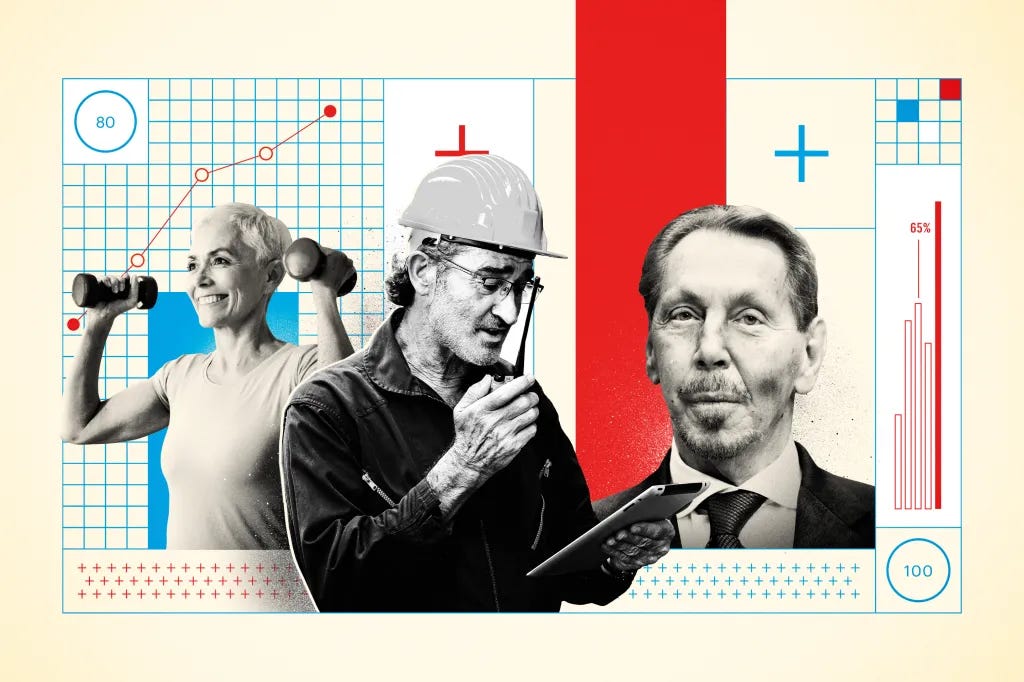
The 100-Year Life Will Reshape Economics
A child born today has a 50% chance of living to 90, according to longevity researcher Andrew Scott. That changes how long people might work, how long they draw benefits, and how long systems are expected to hold up.
Why it matters: In the United States, more than one in six people is already 65 or older. By 2050, that number will pass 80 million. In Europe, the share of working-age adults is projected to fall to 54% by 2100. Fewer workers. More retirees. Longer timelines for everything.
Real-world signal: Larry Ellison has invested hundreds of millions of pounds into generative biology research at Oxford, betting on earlier detection and longer healthspan.
Andrew Scott, economics professor and principal scientist at Ellison’s Oxford institute, told Fortune, “Nearly all employment growth in the future will come from people over 50… If we could just halve the rate of decline, we would see a 4% boost to GDP. That’s the closest thing to a free lunch for growth that I can see.”
Yes, but: More than 80% of healthcare spending happens in the final decade of life. Preventive care and longevity services are expanding fastest among households that can afford them.
Hidden insight: The debate is no longer about whether we will live longer. It’s about who pays, who works, and how long the systems around us can stretch.
Takeaway: Longer lives don’t just extend retirement. They extend responsibility.
Source: Fortune
The Generation Built To Translate
Generation X grew up before the internet ran the office. They learned email, mobile phones, and now AI on the job. Many expected experience to translate into leadership. The numbers suggest something more complicated.
Why it matters: Only 15% of Gen X employees hold executive roles, compared with 20% of Millennials. Just 28% hold senior-level positions. As older executives stay longer and younger workers rise quickly, the middle narrows.
Real-world signal: The Mather Institute calls it a “leapfrog” effect.
The report states, “This leapfrog effect could be due to workplace ageism, the assumption that Gen Xers will be retiring soon, and millennials’ reportedly greater comfort with using artificial intelligence in the workplace.”
Yes, but: Boomers are staying in the workforce longer than previous generations, which slows turnover at the top.
Hidden insight: Gen X reports the strongest intention to stay with their employer the longest. In an era of longer careers, stability is an asset.
Takeaway: Promotion systems built for shorter careers are starting to show strain.
Source: HCA Magazine
The Real Luxury In Later Life Is Visible Neighbors
Liberty Tiny Village in Aubrey, Texas, sits on 7.5 acres with 11 occupied lots. Homes cost between $75,000 and $160,000. Monthly lot rent is $950. On paper, that looks like a smaller mortgage. Residents describe something else.
Why it matters: Aubrey’s median home price reached $303,550. Typical rent runs $2,267. Selling a larger house and buying outright changes monthly math. It also changes who notices if you don’t step outside for a day.
Real-world signal: Most residents buy their homes outright, and their main monthly expense becomes the $950 lot rent that covers basics like water, sewer, trash, landscaping, and WiFi. Designer Kristene Newton told Business Insider that the cost structure can land well for residents living on savings, investments, and Social Security.
Debbie Giamalva, 70, said, “If something happened to you in your place, everybody would know if they didn’t see you.”
Yes, but: The community is small and not widely accessible. It doesn’t solve affordability at scale.
Hidden insight: The appeal isn’t just square footage. It’s proximity. First-floor bedrooms, ramp options, shared events, and a group chat create daily visibility.
Takeaway: In later life, independence and interdependence often sit side by side.
Source: Business Insider
The Constraint Making Long Life Coherent
The longevity economy is projected to reach $27 trillion by 2030. Investment in healthspan continues to grow. Mortality does not. Research on hospice patients shows a pattern. Status fades in importance. Relationships move forward.
Why it matters: People nearing the end of life often talk about connection, gratitude, and service. Those reflections appear consistently in studies cited in Time.
Real-world signal: Joanna Ebenstein, author of Memento Mori, writes, “The mystery of death has, for millennia, led us to ask the big, existential questions: Why are we here? What is the meaning of life?”
Arianna Huffington writes, “Death is not a glitch, but a clarifier.”
Yes, but: Healthspan research continues to push earlier intervention and preventive care.
Hidden insight: Living longer stretches the timeline. It doesn’t remove the boundary.
Takeaway: The stress test isn’t just financial or structural. It’s personal.
Source: Time
Until next time,
Rethink Aging With Us
This is for you and you’re in the right place:
If you’re in your 30s, 40s, 50s, or beyond and not ready to fade out.
If you’re a builder, strategist, or decision-maker trying to understand what aging really means for your product, team, city, or community.
If you’re tired of “decline narratives” about age and are ready for something more honest, more useful, and more human.
Join other curious and forward-thinking people who are reconsidering what older age can be — and how to live it with intention.
Share age/proof design
Enjoyed this issue? Please forward this to friends or share by clicking below:
Bryan, the share about the 100-year-old-life prep really resonated with me.
Thanks for the insights Bryan as always. I'd like to see the 100-year-old life be one where it doesn't take 80% of the healthcare spending happening in the later years because we took better care of ourselves well ahead of time and the related preventative healthcare was covered. by insurance instead of just covering treatments, medicines and surgeries.